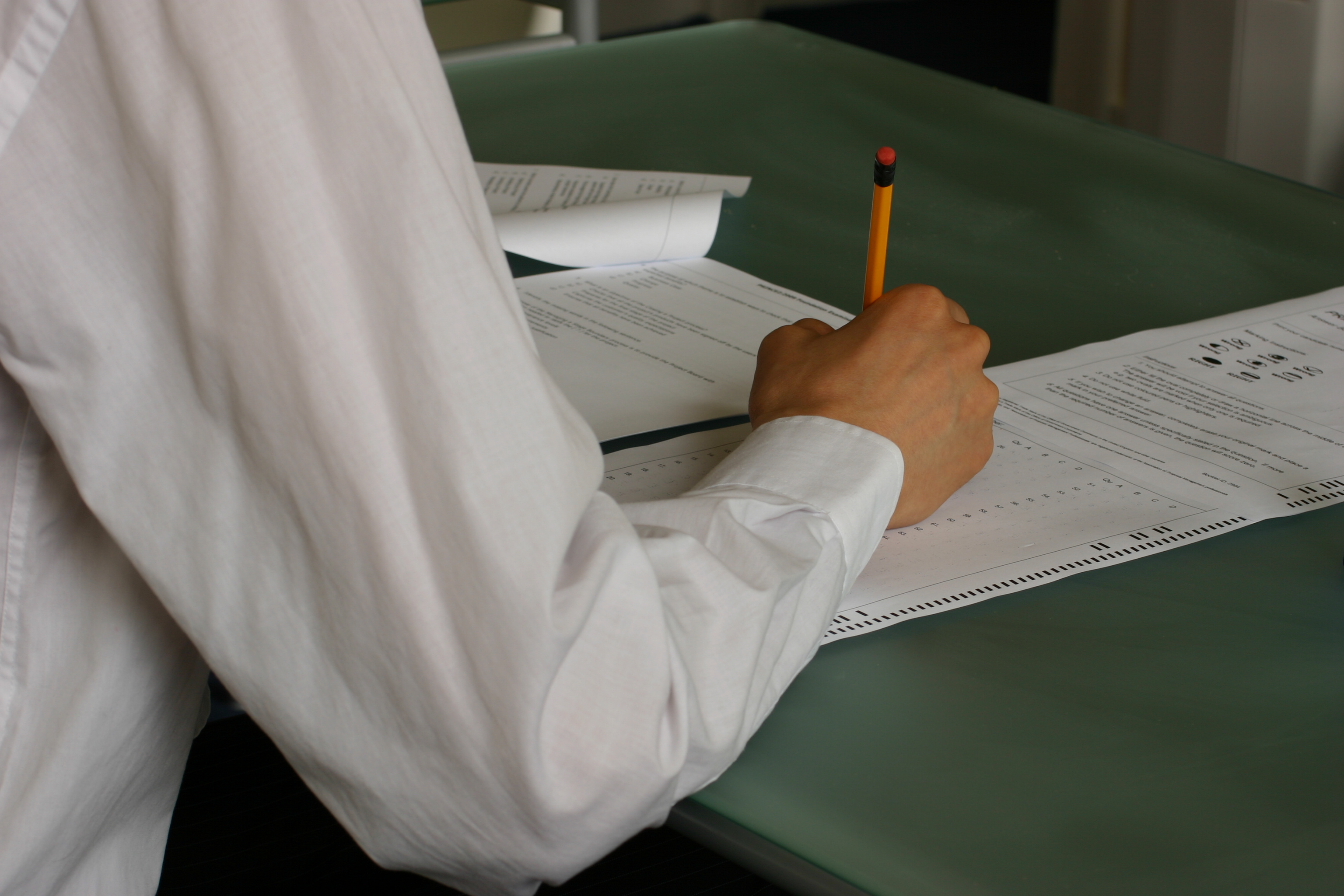
The Central Board of Secondary Education has held the line on its earlier guidance: Class 12 results for the 2026 cycle should be out in the third week of May. The Controller of Examinations told reporters this week that the on-screen evaluation process is "on schedule" and pushed back firmly against rumours of a delay. For the more than 18.5 lakh students who appeared between February 17 and April 10, that puts the result window broadly between May 11 and May 17.
What is genuinely different this year is not the timing — it is how the answer scripts were checked. CBSE has moved to a fully digital On-Screen Marking system for Class 12 for the first time, and that single change carries downstream effects parents should understand before the marksheet drops.
What On-Screen Marking actually means
Until last year, CBSE's evaluators received physical answer booklets at marking centres. They wrote marks in ink on the cover sheet, totals were tallied by hand, and bundles moved between centres in sealed cartons. The whole chain was paper-first.
From 2026, scanned answer scripts are reviewed on screen. Examiners log in to a secure portal, see one question's response at a time across many candidates, and award marks digitally. The board's stated goals are speed, internal consistency between examiners, and a smaller margin for arithmetic errors at the totalling stage. CBSE has also restructured the science answer booklet so physics, chemistry, and biology each have their own clearly marked section — answers written in the wrong section will not be marked.
Independent reporting on the change is consistent on the mechanics. Business Today's coverage notes that the digital workflow is the main reason CBSE is sticking to its third-week-of-May commitment despite the volume of scripts. The board itself has called reports of OSM problems "completely false".
Three things that change for the marksheet itself
1. Faster availability of scanned scripts
The recheck and revaluation cycle has historically been the slowest part of the post-result process because students had to formally request a photocopy, wait for the physical booklet to be retrieved, and then file objections. With OSM, the scripts already exist as PDFs in CBSE's system. Parents and students should expect the photocopy and revaluation windows to open faster — possibly within a week of the result — and complete in a tighter cycle than 2025's.
2. More uniform marking across regions
Internal QA is easier when every script and every examiner's marks live in one database. CBSE can flag outlier examiners — those marking too leniently or too strictly relative to peers — and route a sample for review before results are finalised. The practical implication is fewer "lucky" or "unlucky" school batches and a tighter band of marks for similar quality answers.
3. Cleaner totals on the marksheet
Hand-tallied totals occasionally produced 1- to 3-mark errors that were caught only at recheck. With digital totalling, that class of error largely disappears. Parents who plan to file revaluation should focus on subjective sections — the long-form questions where genuine examiner disagreement is possible — rather than re-checking arithmetic.
The next two weeks at home: a practical playbook
The fortnight before a board result is when families lose sleep that they cannot recover. A few small structural moves help:
- Lock down login details now. Class 12 results will be available on results.cbse.nic.in, cbse.gov.in, the UMANG app, and DigiLocker. Make sure your child's roll number, date of birth, and school code are written down somewhere outside their phone notes — servers go down on result day and DigiLocker authentication can fail intermittently.
- Pre-decide the recheck threshold. A useful rule: if a subject score is more than 8 marks below the highest reliable internal benchmark (a pre-board, a prelim, or a school assessment), it is worth ordering a photocopy. Smaller gaps usually do not move on revaluation.
- Have a Plan B college list ready. Most central university and state quota cut-offs publish within ten days of CBSE results. Families that wait for the result to start research lose the first round.
- Don't watch the social timeline. The hour after results post is the worst time to be on a parent WhatsApp group. Read the marksheet, then close the app for a day.
What this means for school administrators
For schools, the OSM transition is also a curriculum-feedback opportunity. Once the result is in, examiner-level data — anonymised question-wise performance — gives a sharper picture of where teaching went well and where it did not. Last year that data took four to six weeks post-result. This year it should arrive sooner. Heads of department who plan their July review meeting around it will be ahead of the cycle.
What this means for Class 12 families
The headline this year is not the result date — it is the audit trail. For the first time, every mark on the Class 12 marksheet has a digital chain of custody. That makes the result more trustworthy, and it makes the recheck process meaningfully more useful. Use that. The next two weeks belong to the student. The two weeks after that — admissions, course choices, second-attempt decisions — belong to the family.
If you are weighing colleges, board options for a younger sibling, or thinking through a school change for the new academic year, explore Meetschools for OTP-verified parent reviews and a school-by-school view across Indian metros.